



‘The situation has changed significantly beyond ourexpectations — this is indeed a very challenging time’ –Le Thi Thuy Trang, Siam Canadian Group
By Neil Ramsden | March 27, 2026 08:50 GMT
Vietnam’s pangasius sector is being squeezed by the hike in various costs caused by the ongoing conflict in Iran, with farm-gate prices high and steady and export prices climbing.
“Due to the conflict in the Middle East, the situation has changed significantly beyond our expectations,” Le Thi Thuy Trang, Sales Manager for Siam Canadian Group’s Vietnam office, told Undercurrent.
“Freight, packaging, and fuel costs have all increased, putting considerable pressure on overall pricing. This is indeed a very challenging time.”
As reported, the Vietnam Association of Seafood Exporters and Producers (VASEP) had warned exporters faced sharply rising transportation costs, longer shipping times and growing logistics uncertainty.
Earlier in March, Vietnamese seafood exporters said the most immediate impact was not weakening demand but higher logistics costs and transport risks. Some international shipping lines have begun
avoiding high-risk areas, diverting vessels around Africa instead of using traditional routes through the Middle East.
“Although packers and farmers are trying to keep raw material and fingerling prices stable compared to the past two weeks, the selling price has increased, mainly due to higher freight and packaging costs, “Trang continued, speaking on March 24.
“In addition, with the current hot weather in the Mekong Delta, farmers are reluctant to stock fish. As a result, we expect the shortage of raw materials to continue, possibly until July.”
A second source in the Vietnamese sector added that the hot weather makes nursery fish more susceptible to bacterial diseases affecting the liver and kidneys.
The prices for procuring 800-gram to 1.0-kilogram and 1.0-1.2kg fish spiked at the start of the year, while the largest sizes — 1.2kg+ — remained steadier.
The cost of the smaller fish had eased before embarking on a climb either side of the Lunar New Year holiday in mid-February, according to updates from a Ho Chi Minh City-based consultancy commissioned by UCN to gather and analyze data.
That climb halted in week nine, when the US and Israel attacked Iran.
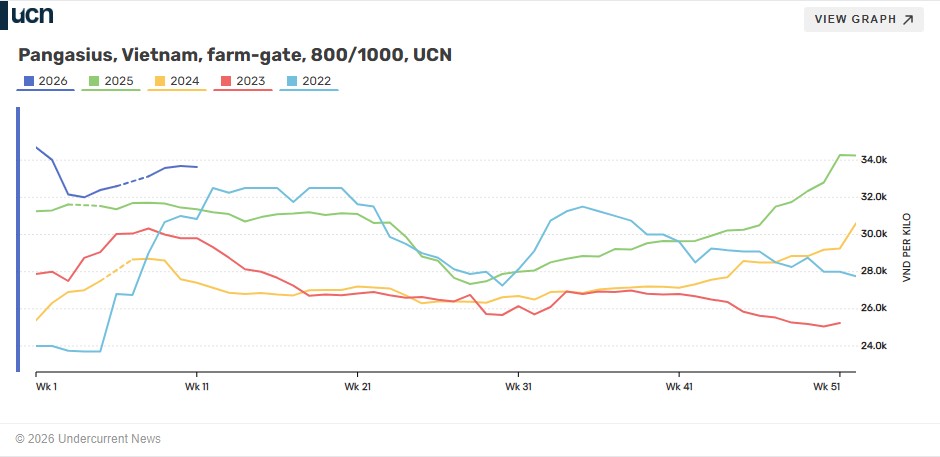
Prices for 800g-1.0kg and 1.0-1.2kg pangasius — the preferred range for producing fillets sent to the EU and US, with the US preferring the larger end of that range — have been essentially stable at almost VND33,700 ($1.28)/kg as of week 11 (March 9-15).
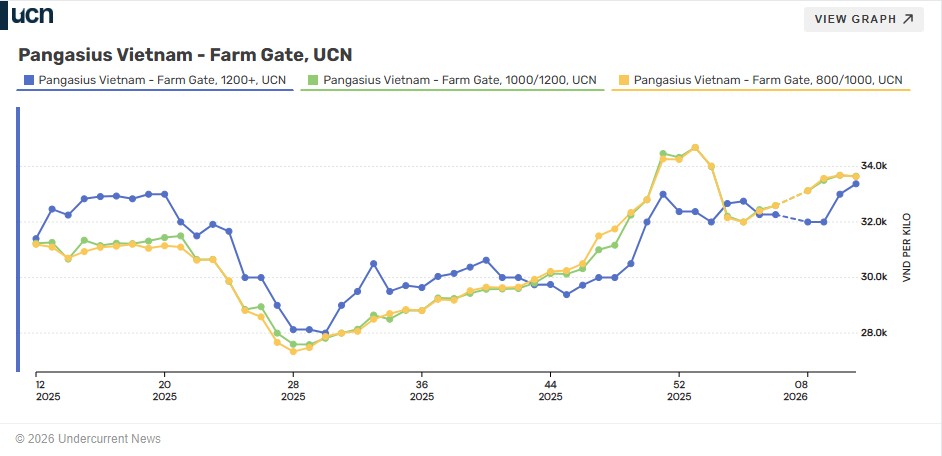
However, it’s been the turn of the largest fish, weighing 1.2kg+, to climb, from VND 32,000/kg to almost VND 33,400/kg as of week 11. These fish are preferred by the Chinese market.
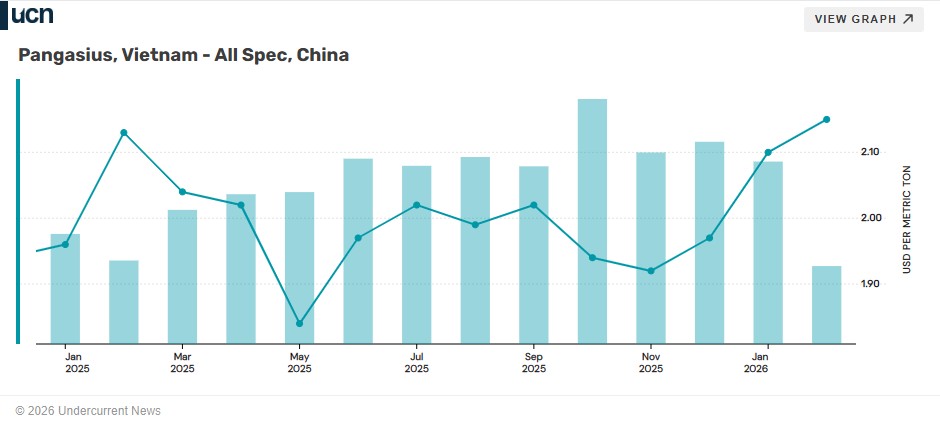
For the first two months of the year, the export value reached $94m, a sharp increase of 86%, mainly due to increased purchases by Chinese importers to serve the Lunar New Year holiday.
Customs data supplied to Undercurrent shows that while volumes shipped to China in February were quite static, the average price across all pangasius products rose sharply:
The US ranks second on the list of import markets. In February, pangasius exports to the US reached $18 m, down 19% y-o-y.
For the first two months of the year, exports totaled $38m, a dip of 5%, partly reflecting the “slowing consumption trend and the cautious sentiment of importers regarding changes in tariff policies in the US market,” said VASEP.
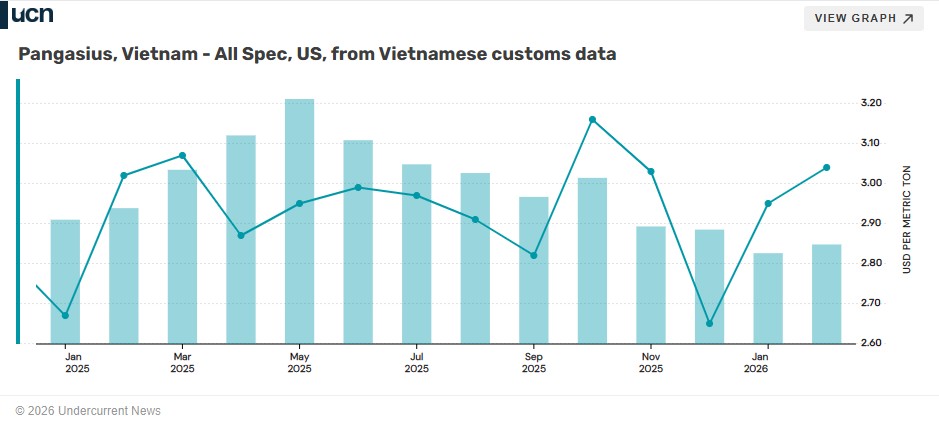
Brazil ranked third, with exports there down 27% y-o-y to $10 m in February — but cumulative exports to this market for the first two months of the year still reached $29 m, an 8% increase.
The aforementioned consultancy expects customs data to have shown that pangasius exports rebounded across most markets (except the Middle East) in March, compared to February, “but may remain lower than in January due to strong fluctuations in oil prices, freight rates, and the ongoing conflict in the Middle East, which is forcing vessels to reroute and increasing transit times.”
“The outlook for the future still presents some challenges,” said VASEP. “In the EU market, there is a shortage of whitefish, but China and Brazil are increasing tilapia exports to the region, potentially making the mid-range product segment more competitive for Vietnamese pangasius.”
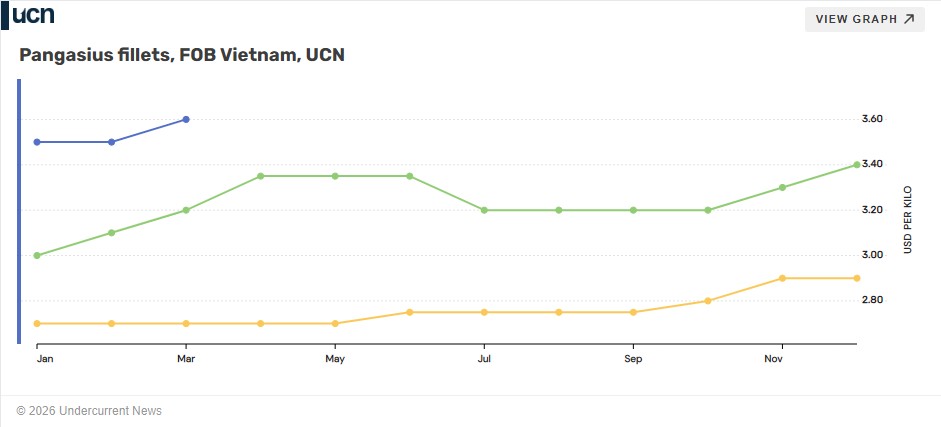
“Furthermore, the geopolitical situation in the Middle East continues to be complex, increasing the risk of disruptions to shipping routes and leading to higher logistics costs, which could affect import demand and delivery schedules for seafood in this region and other parts of the world in the coming period.” UCN’s pangasius fillet assessment for EU imports, shipped free onboard, 100% net weight, shows prices have lifted somewhat in March from an already high level, as exporters attempt to pass on some of the increased costs.
In February, VASEP had said that with farm-gate prices at VND 35,000/kg — up to VND 7,000/kg higher y-o-y — there were “significant profits [for] farmers after a long period of losses.”
“With average production costs of around VND 24,000-26,000/kg, pangasius farmers can achieve a profit of VND 8,000-10,000/kg,” it noted. “This is considered a ‘dream’ profit margin for many farming households, given the high prices of feed, fingerlings, and capital costs over the past several years.”
A short supply of fish, but relatively stable farming costs, had meant a brief period of profits; that may now be interrupted by the volatility that’s hitting so many sectors that ship across the world.
Fingerling prices spike, drop back
The prices farmers pay to restock their ponds with juvenile fish were high in 2025, and historically so since late summer as levels climbed.
Weeks three to six of 2026 saw levels come down and stabilize at a noticeably higher level y-o-y.
Prices climbed sharply after the Lunar New Year, before dropping 12.8% in week 11, presumably because of the above-mentioned unwillingness to stock again amid inclement weather.
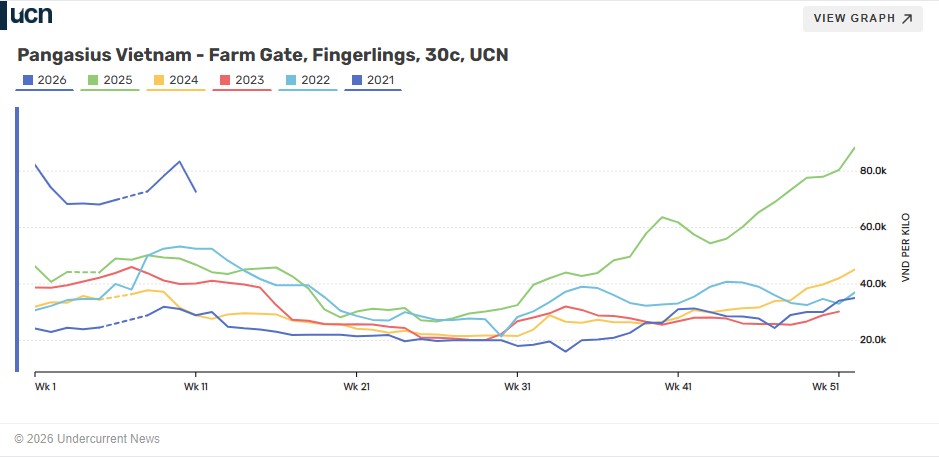
It was only one month previously that VASEP had said the cold weather had led to higher mortality rates for fingerlings.
The high price of fingerlings has made many farmers hesitant to restock, fearing the risks when commercial fish prices reverse, it said.