

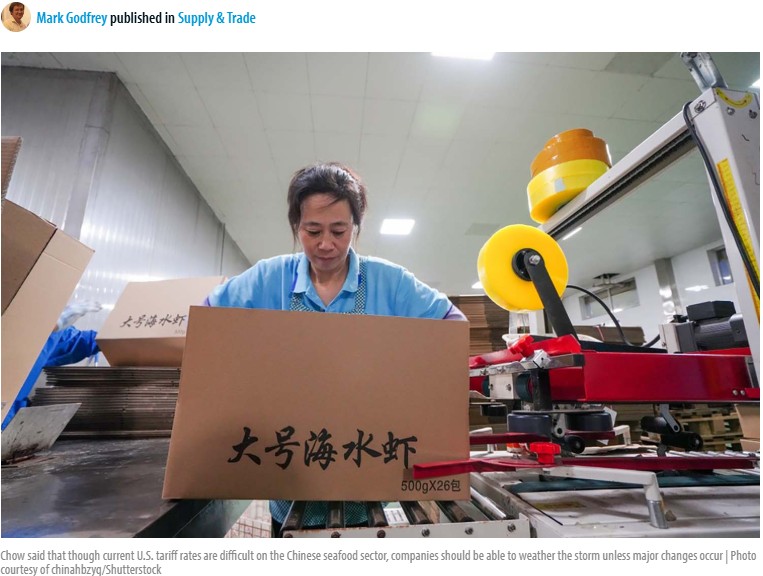
U.S. tariffs on Southeast Asian nations like Vietnam have helped to cushion the impact of trade disruptions on Chinese processors and exporters, according to Landy Chow, the general manager of seafood exporter Siam Canadian’s China office.
The U.S. recently instituted 20 percent tariffs on Vietnamese goods, down from the 42 percent it was initially threatened with. Chinese seafood, meanwhile, faces 30 percent tariffs, as well as 25 percent Section 301 tariffs, resulting in a 55 percent overall tariff rate.
Chow said that the 35 percent gap between the two nations is only a 10 percent widening of the gap compared to 2018, when China was tariffed at 25 percent and Vietnamese goods entered the U.S. tariff-free.
This, according to Chow, leaves China with a good chance to still dominate such sectors as tilapia because importers most likely won’t be scared off by that small increase and “because Chinese tilapia fillets are still about 30 percent cheaper than Vietnam’s.”
Though Chow is optimistic about the current situation, he added a caveat that Sino-U.S. trade could shift in any direction, which will affect China’s seafood sector accordingly.
If tariffs remain the same, Chinese exports will be impacted but to a limited degree, Chow said, predicting Chinese contract processors will be able to survive current rates.
“The impact is there but not that serious,” he said.
In another scenario in which the U.S. and China reach an agreement and the U.S. lowers duties by 10 percent to 20 percent, for example, “that will significantly boost China’s seafood exports to the U.S.,” Chow said.
However, in a scenario where trade hostilities between the two sides worsen, Chow said the effects will heavily “damage the tilapia and other seafood exports drastically.”
As for other species like shrimp, Chow said new tariffs on Vietnam, Indonesia, and India will result in Ecuador being the big winner.
“I would expect more and more buyers will shift their purchasing to Ecuador, which is subject to just a 10 percent duty,” he said.
In the meantime, the Chinese seafood sector is attempting to diversify some sales away from the U.S., trying to guard themselves against trade uncertainty.
One such path is to sell more to the domestic market, and the Chinese government has instituted initiatives to help companies hurt by tariff volatility do just that.
Others are looking abroad to varying degrees of success. Josef Zheng, head of sales at Xiamen Heron Seafood, told SeafoodSource earlier this year that his company will continue to chip away at difficult, distant markets out of sheer necessity.
“China doesn’t have a social security system that’s as generous as that in Europe. This means we have no choice; we have to go out and find markets to survive,” Zheng said.