

Toan Dao published in Aquaculture
Thailand’s shrimp industry is urging the nation’s government to declare the sector’s recovery a “National Agenda” in hopes of significantly boosting production and seize a major trade opportunity in the U.S. market in 2026.
The Thai Shrimp Association is seeking sweeping policy changes to raise annual shrimp output from between 250,000 and 270,000 metric tons (MT) to a targeted 400,000 MT. This goal is primarily driven by a market shift in the U.S., where high import tariffs are currently hindering competitive shrimp-producing nation India and potentially creating a market gap of up to 300,000 MT, Thailand’s The Nation reported.
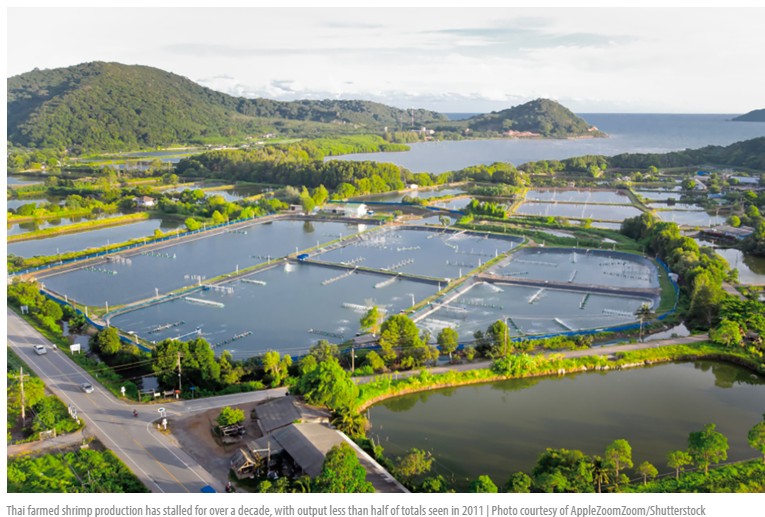
Thailand, which once boasted production upward of 600,000 MT in 2011, has seen output plummet since, primarily due to chronic disease outbreaks and fierce global price competition.
According to Thai Shrimp Association President Ekapoj Yodpinit, the output decrease has cost the nation an estimated THB 650 billion (USD 20.3 billion, EUR 17.5 billion) in lost revenue for the past 13 years.
Now, however, the association wants 2026 to be the “year of recovery,” largely because India now faces U.S. import tariffs exceeding 60 percent and Thai shrimp is subject to a significantly lower tariff of just 1.9 percent, providing a critical competitive edge.
“This is an unparalleled opportunity for Thai shrimp to capture a major share of the U.S. market,” Yodpinit said.
To effectively capitalize on the opportunity, the association is urging the government to enact a “National Agenda” to restore annual production of at least 400,000 MT.
Key demands for the agenda include speeding up free trade agreement (FTA) negotiations with major markets, including the E.U., the U.K., and South Korea, and also call for reducing import duties on main feed ingredients like soybeans and providing low-interest government loans to allow farmers to upgrade decades-old equipment. Additionally, the association has called for increased research budgets to systematically combat persistent shrimp diseases.
“We have been stuck on the 270,000-MT problem for too long,” Yodpinit said. “2026 is the year the market opens. We must produce enough shrimp to grab this opportunity.”
Nevertheless, Will Wangchai, export sales manager at Siam Canadian’s Thailand office, told SeafoodSource that 400,000 MT is highly optimistic, especially as the country has not crossed the 300,000-MT mark in more than a decade.
Beyond persistent disease pressure, Wangchai said several structural constraints are limiting the sector’s growth, including high production costs, aging farming systems, environment and climate disruptions.
“Because of these combined constraints, reaching 400,000 MT is possible only with major structural improvements – far beyond disease control alone,” he said.
Though the Thai government has instituted measured shows increasing its support of the industry’s goals, in practice, the past decade has showcased that these policy measures have not delivered meaningful improvements.
Producers have expressed concern at the lack of low-interest loans or grants for farm upgrades, measures to lower production costs such as tax incentives on feed, greater public investment in disease management research, and subsidies to help farmers modernize their operations. At the same time, Thailand’s slow progress in trade negotiations, including the loss of Generalized System of Preferences (GSP) privileges with the E.U., points to a broader pattern of insufficient support for export competitiveness, Wangchai said.
Additionally, even with India at a disadvantage, Thailand has not managed to regain market share in the United States, as Indonesia and Vietnam remain more competitive suppliers and Thailand’s production and export costs remain comparatively high, according to Wangchai. Additionally, if the U.S. and India eventually reach an agreement to lower tariffs 2026, Thailand would be further disadvantaged in the U.S. market.
However, a secondary effect could work in Thailand’s favor, Wangchai said.
India currently diverts large volumes to Canada and many Asian markets because the U.S. is less attractive under current tariff rates, but if U.S. tariffs fall, India is likely to reallocate more supply back to the U.S., which would ease competitive pressure on Thai exporters in those secondary markets.
Still, Thai shrimp production in 2025 is expected to remain at around 270,000 MT, which would be unchanged from last year. From January to October, exports reached 112,000 MT – up 6 percent year over year. Full-year exports are projected at 126,000 MT worth roughly THB 30 billion (USD 939 million, EUR 806.5 million), which would represent drops of between 4 and 5 percent, respectively, the Bangkok Post reported.