

Toan Dao published in Supply
& Trade
Indonesia’s
seafood industry is grappling with uncertainty following a new reciprocal
tariff announced by U.S. President Donald Trump – a move likely to accelerate
the country’s ongoing efforts to diversify its export markets and reduce
reliance on the U.S.
On
16 July, Trump
announced that the U.S. will impose a 19-percent tariff on
Indonesian goods starting 1 August, a reduction from the 32-percent rate
initially floated on 2 April. The announcement – made via Trump’s
social media platform Truth Social – was later confirmed by
Indonesian President Prabowo Subianto.
As part of the deal, the two countries agreed
U.S. goods will enter Indonesia with zero tariff or non-tariff barriers.
Indonesia also agreed to purchase USD 15 billion (EUR 12.9 billion) in U.S.
energy products, USD 4.5 billion (EUR 3.9 billion) in agricultural goods, and
50 Boeing aircraft.
Previously, goods from Indonesia to the U.S.,
like those from many other countries, were subject to a 10-percent tariff
during the three-month
suspension set by Trump on 9 April.
President Prabowo
said the latest agreement will help take trade between the two countries
to a “new era of mutual benefit” in a post on his official Instagram account,
according to the Jakarta Globe on
16 July.
Siam Canadian Indonesia General Manager Cicilia Darmali told SeafoodSource on 18 July that the 19-percent tariff
announced by the U.S. is more manageable than the previously threatened
32-percent rate.
“As you know, [the]
32-percent tariff will kill our industries as we won’t be competitive in the
market,” she said in an email.
Darmali said despite the news of the
lower tariff, many Indonesian packers remain cautious. Most, she said, are
waiting for the final tariff decisions on India and Ecuador – two of
Indonesia’s main competitors in the U.S. market – before making further
purchases of raw material.
“Currently our packers are
still not aggressive in buying raw material, they are still in wait and see
mode. We all are waiting for the final tariff for Ecuador and India
especially,” she said. “I believe U.S. importers are also waiting for the final
tariff from India before buying more.”
Others
in the seafood industry also remain wary, as while the tariff is lower than
initially expected, it is still high enough it could still pose problems.
Indonesian Fisheries Processing and Marketing
Entrepreneurs Association (AP5I) Chairman Budhi Wibowo said that even a
19-percent duty could undermine Indonesia’s competitiveness, Jakarta Globe reported
on 16 July.
“For us, it’s not about the drop from 32
percent to 19 percent, but the jump from 0 to 19 percent. Even with 10 percent,
we’ve already struggled,” Wibowo said, warning that the new tariff could make
Indonesian seafood less competitive in the U.S.market.
To mitigate the impact on the country’s
seafood exports, AP5I has urged the government to simplify licensing, lower
non-tax state revenue fees, and improve financing access. Wibowo said rising
upstream costs and permit requirements were already putting pressure on margins
even before the tariff announcement.
“With the 19-percent tariff, our working
capital needs will rise by 19 percent since we have to pay the tariff as soon
as containers arrive at U.S. ports,” he said, calling for increased credit
ceilings and lower interest rates from banks.
Economist Eko Listiyanto of the Institute for
Development of Economics and Finance also described the deal as “not ideal,”
though likely the most favorable outcome achievable given Indonesia’s
negotiating leverage, he told Jakarta Globe.
Troy Turkin, CEO of U.S.-based importer
Supreme Crab, told
SeafoodSource that the new tariff on Indonesia would raise
costs for crab shipments already on their way to the U.S. While better than the
proposed 32 percent, the 19-percent rate still poses a
financial challenge, he said.
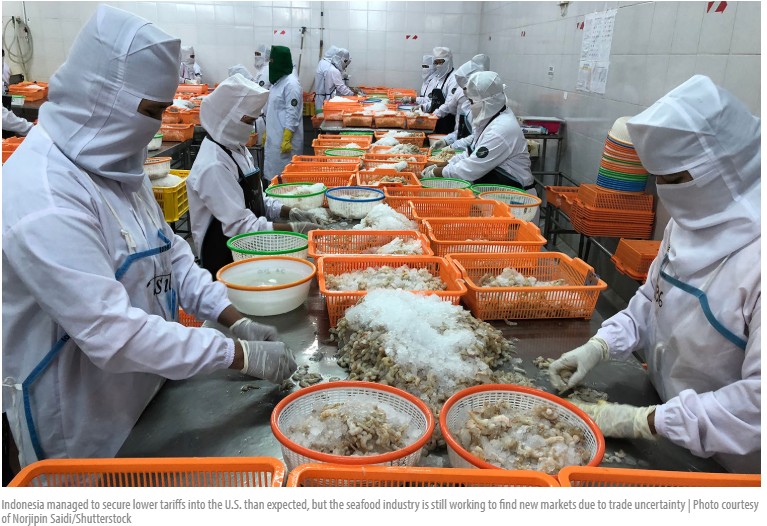
In May, Indonesia exported 21,288 metric tons
(MT) of shrimp, surging 27 percent year-on-year. Of those exports the U.S. was
the largest destination, at 14,458 MT, rising 25 percent year-on-year. The
sharp rise in the month likely reflects a push to expedite shipments ahead of
anticipated trade actions, including the ongoing U.S. anti-dumping review, Shrimp
Insights said in a note on 15 July. The export volume through
the first five months of 2025 also increased 15 percent to 89,224 MT.
Darmali of Siam Canadian Indonesia agreed that the strong performance in the first five
months was largely driven by packers rushing to fulfill large pending orders as
U.S. importers pushed for early shipments to avoid potential tariff hikes.
However, the domestic market in Indonesia is rather stable at the moment.
“Right now [the domestic]
market is quiet. Raw material price is stable for the moment, except for big
sizes: HOSO [head-on, shell-on] 20 and 30 that are on the increasing
trend,” Darmali said.
While
the U.S. remains Indonesia’s largest seafood export market, ongoing tariff
uncertainty had prompted the country to begin diversifying its export
destinations even before the 19-percent tariff was announced.
Indonesia’s Minister of Marine Affairs and
Fisheries Sakti Wahyu Trenggono said on 15 July that the country is looking to
increase exports to Europe and China to mitigate the impacts caused by the U.S.
tariff, Indonesian news agency Antara reported
15 July.
Indonesia’s
Ministry of Marine Affairs and Fisheries (KKP) said that it has signed
bilateral equivalence agreements on fish quality systems with Vietnam, South
Korea, and Canada, enabling it to expand seafood exports to these markets. Head
of KKP’s Quality Assurance Agency Ishartini announced in a statement on 6 July
that his ministry has approved 20 new seafood processing units eligible for
exporting to Vietnam, along with eight to South Korea and six to Canada, Changemakr.asia
reported on 9 July.
Seafood production in Indonesia rose 2
percent year-on-year to 5.58 million MT in the first quarter, thanks to
the growth in cultivated fish output, seaweed production, and capture
fisheries. Fishery exports in the period increased by 2.3 percent
year-on-year in volume, while the export value surged 6.5 percent
year-on-year to USD 1.94 billion (EUR 1.66 billion), Voice of Indonesia reported on 2 July.
Indonesia
exported seafood products worth USD 5.95 billion (EUR 5.1 billion) in 2024. Of
that total, the U.S. was the largest destination worth, USD 1.9 billion (EUR
1.63 billion), China came second at USD 1.24 billion (EUR 1.1 billion), ASEAN
countries came third with USD 854.22 million (EUR 731.6 million) and Japan was
fifth with USD 598.74 million (EUR 512.8 million), the Indonesia
Business Post reported.